The Expanding Role of 5G Technology in Australia’s Startup Ecosystem and Why It Matters More Than Ever

5G technology is often discussed as a faster version of mobile internet, but for startups in Australia, the impact goes much deeper. It is changing how products are designed, how data is processed in real time, and how businesses interact with physical environments.
What makes Australia particularly interesting is its structural contrast. On one hand, there are highly connected urban hubs like Sydney, Melbourne, and Brisbane. On the other hand, large parts of the economy depend on remote operations such as agriculture, mining, and long-distance logistics. This dual reality creates a strong demand for technologies that can reduce distance-related inefficiencies—and 5G is becoming a key enabler.
Why 5G Is a Structural Shift, Not Just an Upgrade
Unlike previous generations of mobile networks, 5G is not only about speed. It introduces three capabilities that fundamentally change product design:
First, ultra-low latency.
This means systems can respond almost instantly. In practical terms, this allows startups to build applications where delay is not acceptable—such as remote machine control, real-time health monitoring, or live logistics tracking.
Second, high device density.
Thousands of devices can operate in a single area without network congestion. This is critical for IoT-heavy startups that deploy sensors across farms, factories, or cities.
Third, improved network reliability.
Systems can maintain stable performance even under heavy load, which is important for enterprise and industrial applications.
Together, these capabilities shift startups from building “apps” to building “connected systems that interact with the real world.”
How Australian Startups Are Rebuilding Product Logic Around 5G
Startups are no longer limited to software-only solutions. Many are designing hybrid systems that combine:
- Hardware (sensors, cameras, devices)
- Connectivity (5G networks)
- Cloud platforms (data processing)
- AI systems (decision-making tools)
For example, instead of simply offering farm management software, agritech startups can now deploy soil sensors that send continuous updates. Instead of basic delivery tracking, logistics startups can monitor temperature, humidity, and route changes in real time.
This shift changes not only product design but also business models. Startups can now charge based on usage, performance improvement, or operational savings instead of traditional subscription models.
For reference on Australia’s digital infrastructure environment:
Industry Deep Dive: Where the Real Value Is Created
Healthcare: From Reactive to Continuous Care
In healthcare, 5G enables continuous monitoring rather than periodic checkups. Wearable devices can transmit real-time data such as heart rate variability, glucose levels, or oxygen saturation.
This allows startups to build early-warning systems that detect health risks before they become emergencies. However, this also raises strict requirements around data privacy and clinical validation.
The Australian Digital Health Agency provides guidance on national standards:
https://www.digitalhealth.gov.au/
Agriculture: Data-Driven Farming at Scale
Australia’s agricultural sector benefits heavily from 5G due to its scale and environmental variability.
Startups can deploy:
- Soil moisture sensors across large properties
- Drone-based crop surveillance systems
- Automated irrigation systems triggered by live data
- Livestock tracking systems for large grazing areas
The real value is not the data collection itself, but decision automation—helping farmers reduce waste, improve yield, and respond faster to environmental changes.
Logistics and Supply Chains: Eliminating Blind Spots
Logistics startups are using 5G to eliminate visibility gaps in supply chains.
Instead of static updates, companies can now access:
- Live vehicle location
- Temperature tracking for sensitive goods
- Automated alerts for delays or route deviations
- Warehouse-level inventory visibility
This is particularly important in Australia due to long transport distances between cities and regional hubs.
Mining and Industrial Operations: Safety and Automation
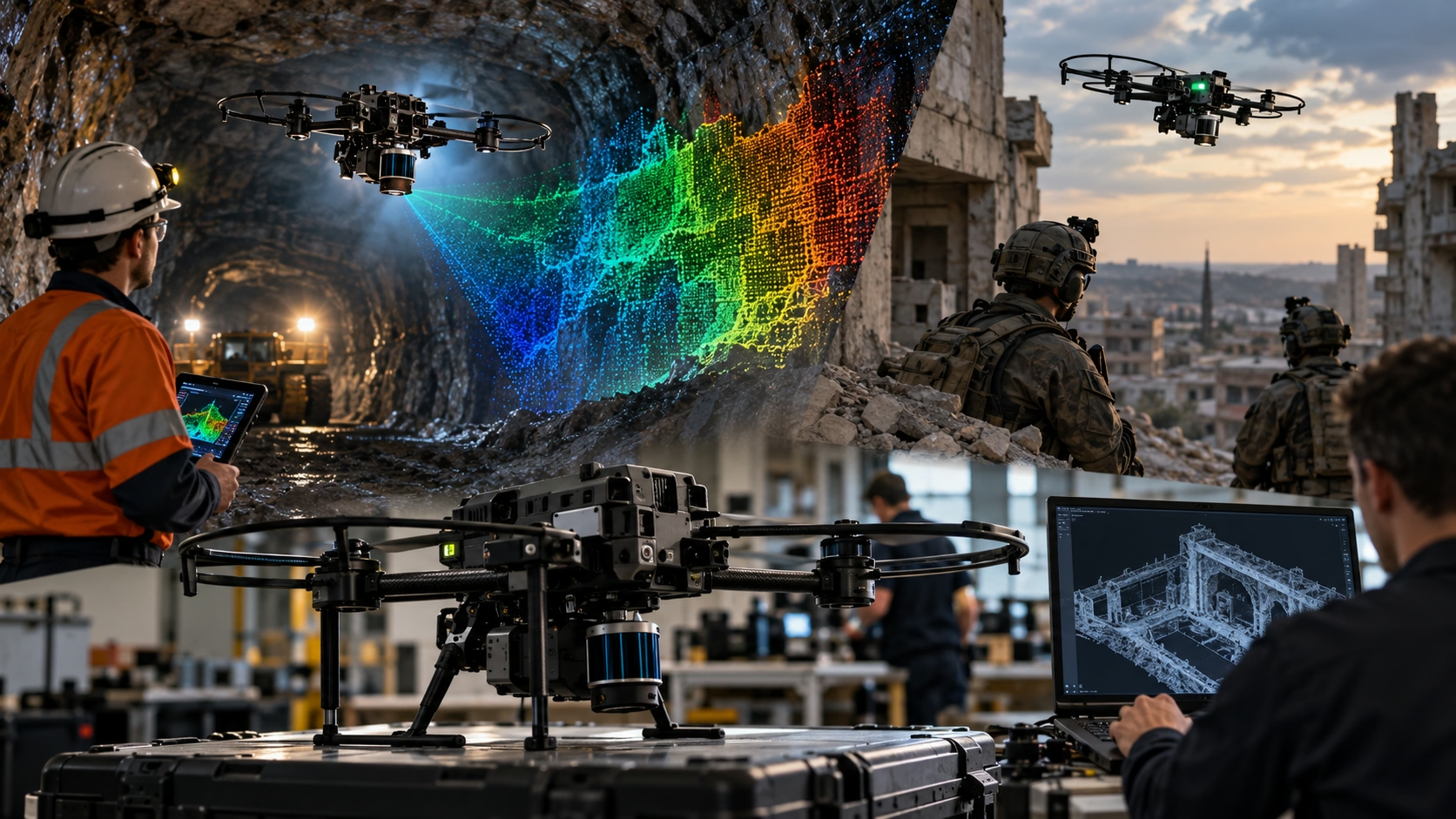
Mining companies are increasingly adopting remote-controlled machinery and predictive maintenance systems.
5G enables:
- Real-time equipment monitoring
- Remote operation of machinery
- Worker safety tracking systems
- Automated hazard detection
Startups in this sector must prioritize cybersecurity and system reliability from the beginning.
Cybersecurity guidance:
https://www.cyber.gov.au/
Smart Cities: Infrastructure That Responds in Real Time
Smart city applications include:
- Traffic flow optimization
- Smart lighting systems
- Waste collection optimization
- Environmental monitoring
However, these projects typically require collaboration with government agencies and long deployment cycles, making them less suitable for fast MVP validation but strong for long-term scaling.
Real Startup Scenarios Using 5G in Practice
A practical example in agritech: a startup installs sensors across vineyards to track humidity and temperature. Instead of manual inspection, farmers receive alerts when conditions indicate disease risk.
In logistics, a startup equips refrigerated trucks with connected sensors that trigger alerts when temperature rises beyond safe thresholds, reducing spoilage risk.
In healthtech, wearable devices send continuous data to a monitoring platform that flags abnormal patterns for doctors to review.
These are not theoretical use cases—they are already emerging in early-stage deployments where infrastructure allows it.
Challenges That Still Limit Adoption
Despite its potential, 5G adoption in startups is not without friction.
Infrastructure variability: Coverage is still uneven across Australia, especially outside major cities.
Cost of deployment: Sensors, devices, and network integration can be expensive for early-stage startups.
Regulatory constraints: Healthcare, transport, and industrial sectors require strict compliance.
Data complexity: More connected devices mean more data, which increases storage, processing, and security demands.
Because of these challenges, many startups adopt a hybrid approach instead of full 5G dependency.
FAQ
Why is 5G important for startups in Australia?
Because it enables real-time systems, IoT scalability, automation, and data-driven decision-making across distributed industries.
What makes Australia a strong market for 5G startups?
Its combination of advanced urban infrastructure and large remote industries creates strong demand for connected solutions.
Do startups need to build fully 5G-based products?
No. Most successful startups use a hybrid model that combines 5G with other network types.
What is the biggest barrier to adoption?
Uneven coverage and high implementation complexity in early-stage development.
Featured Snippet Answer
5G technology is transforming startups in Australia by enabling real-time connectivity, IoT scalability, and automation across healthcare, agriculture, logistics, mining, and smart cities. Its main value lies in supporting systems that require instant data processing and interaction with physical environments.